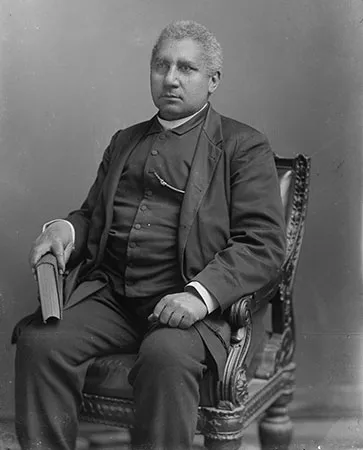
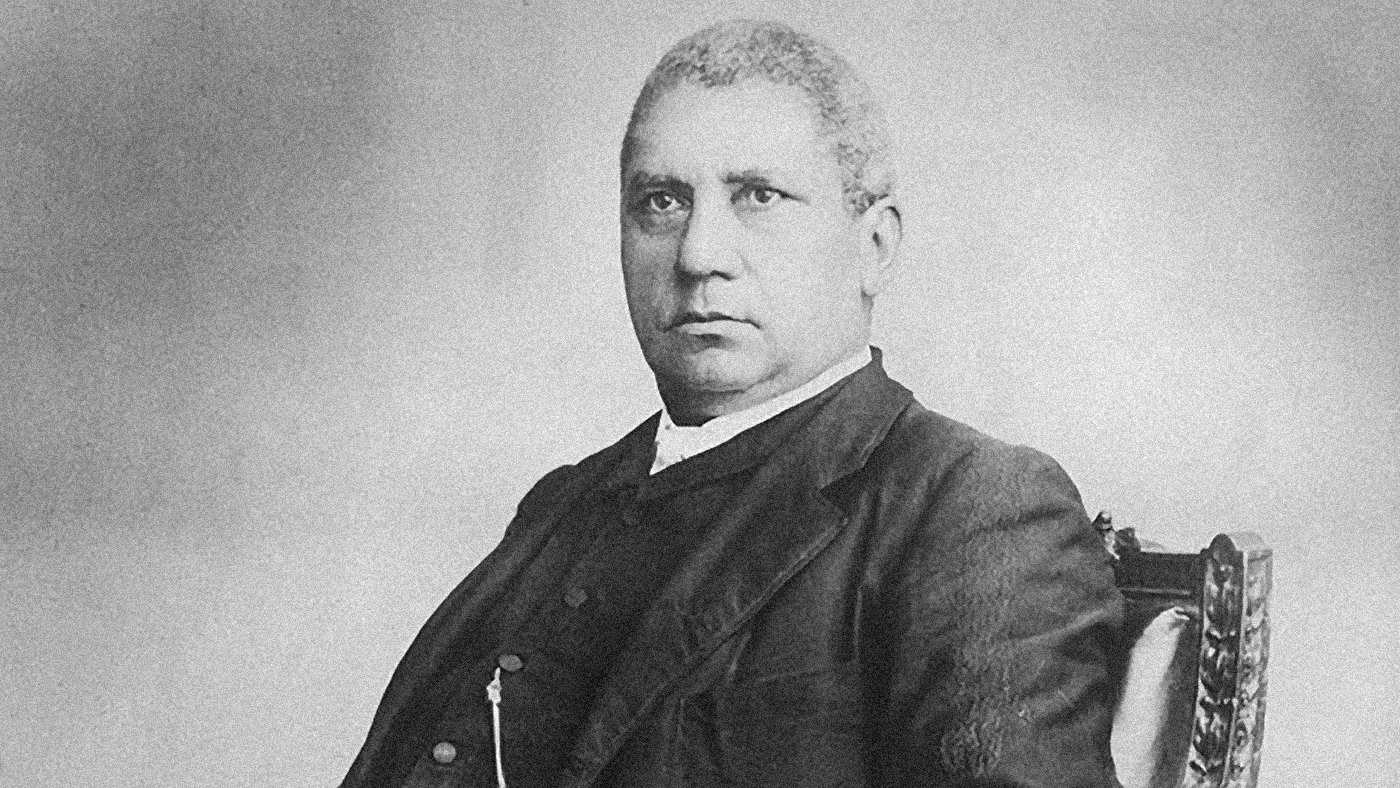
The 12th elected and consecrated bishop of the African Methodist Episcopal Church (AME) was Henry McNeal Turner, an American politician and pastor who lived from February 1, 1834, to May 8, 1915. He labored to start new A.M.E. churches among African Americans in Georgia following the American Civil War. Turner, who was born free in South Carolina, became a Methodist preacher after learning to read and write. In 1858, he became a minister at the AME Church in St. Louis, Missouri. The A.M.E. Church was the first autonomous black denomination in the United States, founded in the early 19th century by free blacks in Philadelphia, Pennsylvania. Turner later served as a preacher in Washington, DC, and Baltimore, Maryland.
Henry McNeal Turner was selected by the US Army as the first African-American chaplain in the US Colored Troops in 1863, during the American Civil War. He was assigned to the Freedmen’s Bureau in Georgia following the war. During the Reconstruction era, he settled in Macon and was elected to the state assembly in 1868. He was an AME missionary who, following the war, established numerous AME churches in Georgia. He was chosen as the AME Church’s first Southern bishop in 1880 following a contentious dispute within the denomination due to its Northern origins.
He started to promote black nationalism and black emigration to Africa after the Democrats regained control of the South in the late nineteenth century and enacted Jim Crow laws. The American Colonization Society initiated this endeavor prior to the Civil War. The majority of African-American leaders at the time were fighting for rights in the United States, and Turner was the main proponent of such emigration to Liberia in the late nineteenth century.
Henry McNeal Turner Biography
Early Life
Sarah Greer and Hardy Turner, both of mixed African and European descent, welcomed Henry McNeal Turner into the world in Newberry, South Carolina, in 1834. According to some accounts, he was born in Abbeville, South Carolina. His paternal grandparents were an African guy and a white woman who worked as a planter. Because the white mom was both free and white, her mixed-race children were born free under the colony’s slave laws.
The family’s oral history states that his maternal grandfather was brought to South Carolina as David Greer after being sold into slavery on the African continent. After discovering that he had royal Mandingo tribal marks, slave dealers released him from slavery. According to the same family lore, Greer began to work for a Quaker family in South Carolina. Greer married a free African woman. Henry Turner was raised by his maternal grandmother and mother, Sarah (Greer) Turner.
Teaching Africans to read and write was illegal in South Carolina at the time. Henry McNeal Turner fled to Abbeville after being forced to work alongside captive Africans in cotton fields as an apprentice. He was hired by an Abbeville law office as a caretaker.
Early Career
Henry McNeal Turner pledged to become a preacher at the age of 14 after being moved by a Methodist revival. In 1853, at the age of 19, the Methodist Church South granted him a preacher’s license (the national church had split into North and South parts in 1844 over slavery and other matters). Turner spent a few years touring the South as an evangelist and exhorter—a role often held by young, single males.
After getting married two years prior, he relocated to Saint Louis, Missouri, in 1858 with his little family. He was afraid that members of his family may be abducted and sold into slavery due to the desire for slaves in the South, as has been documented for hundreds of free Black people. The Fugitive Slave Law of 1850 provided limited safeguards for free Blacks against unlawful capture and enhanced incentives for the capture of fugitive slaves. Slave traffickers and those employed as slavecatchers needed to provide minimal proof of a person’s slave status.
The African Methodist Episcopal Church (AME), the nation’s first autonomous black denomination, was established in Philadelphia, Pennsylvania, and Henry McNeal Turner was consecrated as a preacher in St. Louis. At Trinity College, he studied divinity, Hebrew, and the classics.
In the early 1860s, Turner encountered powerful Republicans while serving in pastorates in Baltimore, Maryland, and Washington, DC.
Henry McNeal Turner was still in training in Baltimore when the Civil War started. He was sent to the largest AME church in Washington, D.C., Israel Bethel Church on Capitol Hill, in April 1862. It was close to the center of Virginia’s government and conflict. Turner’s sermon was attended by congressmen and army officials.
Marriage and Family
Turner wed Eliza Peacher, a rich free black contractor’s daughter from Columbia, South Carolina, in 1856. Four of their fourteen children survived to adulthood. In 1889, Eliza passed away.
In 1893, Henry McNeal Turner, a widower, wed Martha Elizabeth DeWitt. In 1900, following her passing, he wed Harriet A. Wayman. In a few years, she also passed away. He outlived three of his four wives and wed Laura Pearl Lemon in 1907.
Civil War
Henry McNeal Turner was named chaplain of Company B of the First United States Colored Troops, one of the first black battalions formed during the American Civil War. He encouraged “contrabands” and free-born Black people to enlist. (The latter phrase describes enslaved individuals who managed to flee slavery and were deemed “unreturnable” due to their former masters’ involvement in hostilities with the US government). Turner emphasized that the “destiny of their race depended on their loyalty and courage” in his frequent sermons to the men during their training. To hear Turner’s patriotic remarks, the regiment frequently marched to his church. The unit had finished forming and was getting ready to go to war in July 1863. Turner became the only Black officer in the 1st USCT when he was commissioned as chaplain in November of that year.
During the Civil War, Henry McNeal Turner found that the responsibilities of a Union army chaplain were unclear. Chaplains taught at army installations prior to the war. The responsibilities grew to include visiting the ill and injured in hospitals, conducting church services and prayer gatherings, and burying the dead during the conflict. Based on his own skills and the expectations of the troops under his supervision, each chaplain had to determine his place in his regiment. Turner was able to increase his influence among African Americans because to this appointment.
For two years, Henry McNeal Turner served as a chaplain. He contracted smallpox shortly after reporting for duty and was hospitalized for months to recover. In May 1864, shortly before they engaged in their first combat, the Battle of Wilson’s Wharf on the James River, he rejoined his unit. His troop took part in the battle around Petersburg and Richmond, Virginia, from May to December. They participated in the big amphibious assault against Fort Fisher at the end of the year.
Henry McNeal Turner and his soldiers accompanied Sherman’s march through North Carolina in the spring of 1865. He was dispatched to Roanoke Island to assist in managing a sizable settlement of emancipated people once the conflict was over.
He was commissioned as chaplain of another African-American regiment that was assigned to the Freedmen’s Bureau in Georgia after being discharged in September. He deserted the service and resigned shortly after getting there.
He focused on black nationalism, politics, civil rights, and evangelizing Southern freedmen on behalf of the A.M.E. Church. During the Reconstruction era, Turner entered politics and was elected to the state legislature. In addition, he was a national racial leader and a strong clergyman. Turner had developed his ideas about the African race and its prospects in America while serving in the army.
Two wartime-related activities brought him more public exposure. First, readers and lovers in the North took notice of him after he wrote multiple letters from the battlefield that were printed in newspapers. His foundation for a lifetime of journalism was these. Second, he recruited freed individuals into the A.M.E. Church in the initial months following the war by using his role as army chaplain. The majority of emancipated slaves had previously attended churches that were dominated by white people. African-American life was significantly impacted by the autonomous AME Church’s growth in the South. Of the fourteen black chaplains chosen during the war, Henry McNeal Turner was the first. Numerous missionaries from the A.M.E. Church and the New York-based A.M.E. Zion Church also appealed to Southern freedmen.
President Andrew Johnson appointed Turner to assist the Freedmen’s Bureau in Georgia during Reconstruction following the war. Some Freedmen’s Bureau operations were also run by former military officers and white clergy from the North.