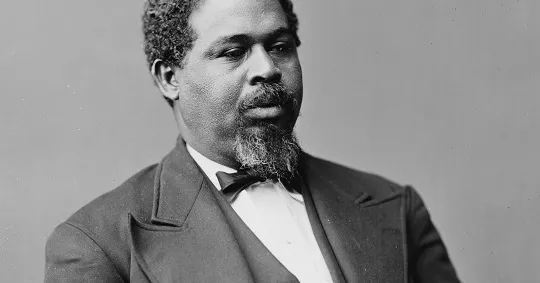
Born into slavery in Beaufort, South Carolina, Robert Smalls was an American Republican politician who lived from April 5, 1839, to February 23, 1915. Smalls, who was still a slave, stole a Confederate transport ship in Charleston Harbor during the American Civil War and sailed it from the harbor’s Confederate-controlled waters to the American blockade that ringed it. After that, he took the ship to the Beaufort–Port Royal–Hilton Head enclave under Union control, where it was converted into a Union battleship. He set himself, his crew, and their families free in the process. President Abraham Lincoln was persuaded to admit African-American soldiers into the Union Army by his example and persuasiveness.
Robert Smalls returned to Beaufort after the Civil War and entered politics. During the Reconstruction era, he was elected as a Republican to both the US House of Representatives and the South Carolina Legislature. He wrote state law establishing the nation’s first free and mandatory public education system in South Carolina. Prior to Mick Mulvaney’s election in 2010, he was the final member of the Republican Party of South Carolina to serve as the state’s fifth congressional district representative.
Early Life
Lydia Polite, a slave owned by Henry McKee, gave birth to Robert Smalls on April 5, 1839, in Beaufort, South Carolina. He was born in a cabin at 511 Prince Street in Beaufort, South Carolina, behind McKee’s home. He was influenced by his mother’s Lowcountry Gullah culture while growing up in the city. Although she had worked in the fields as a child, his mother was employed as a domestic worker. Smalls’ mother requested that he be forced to labor in the fields and observe whippings because she was concerned that he might not grow up understanding the struggle of enslaved field workers because McKee preferred Smalls over other enslaved persons.
At the age of twelve, Smalls’s master sent him to Charleston at his mother’s request to work as a laborer for sixteen dollars a week, of which he was permitted to keep one dollar and his master would receive the remaining amount. Smalls started out as a hotel employee before switching to street lamplighting. His passion for the water brought him employment on Charleston’s ports and wharves during his adolescence. Robert Smalls began his career as a longshoreman, rigger, and sailmaker before rising to the position of wheelman, which is essentially a helmsman, despite the fact that slaves were not allowed to hold that title. He therefore had extensive knowledge of Charleston Harbor.
On December 24, 1856, Robert Smalls, at 17 years old, wed Hannah Jones, an enslaved hotel maid, in Charleston. She already had two daughters and was five years his senior. In February 1858, Elizabeth Lydia Smalls, their first child, was born. Robert Jr., their son born three years later, passed away at the age of two. Smalls wanted to buy them outright to pay for their freedom, but the cost was high at $800 (or $27,997 in 2024). Only $100 had been saved by him. He may have needed decades to get to $800.
Civil War Escape Hero
The Battle of Fort Sumter in neighboring Charleston Harbor in April 1861 marked the start of the Civil War. Under the authority of Brigadier General Roswell S. Ripley, Charleston’s District Commander, Robert Smalls was tasked with navigating the CSS Planter, a lightly armed Confederate troop ship, in the fall of 1861. Planter’s responsibilities included surveying streams, planting mines, and transporting troops, supplies, and dispatches. Smalls flew the Planter on local rivers, across Charleston Harbor, and around the shores of South Carolina, Georgia, and Florida. Seven miles from Charleston Harbor, Robert Smalls and the crew of the Planter could see the line of federal blockade ships in the outer harbor. Robert Smalls seemed happy and had the trust of the owners and crew of the Planter, but at some point in April 1862, he started organizing an escape. With the exception of one, whom he did not trust, he spoke with every other enslaved member of the crew about the issue.
The Planter stopped at Coles Island, a Confederate fortification on the Stono River that was being decommissioned, on May 12, 1862, ten miles southwest of Charleston. Four huge guns were picked up by the ship there and sent to a fort in Charleston Harbor. The crew returned to Charleston and loaded the Planter with 20 cord (72 m3) of firewood and 200 lb (91 kg) of ammunition.
The Planter was docked as usual at the quay beneath General Ripley’s headquarters on the evening of May 12. Robert Smalls and the crew remained on board as its three white officers disembarked to spend the night on land, “as was their custom.” (Afterwards, two of the Confederate commanders were found guilty and the other three were court-martialed; however, the verdicts were later reversed.) Robert Smalls asked Captain Relyea before the officers left whether the crew’s families may come visit, which was sometimes permitted, and he agreed as long as they left before curfew. The soldiers told the families about the plan when they got there.
This was the first the women and children had heard of it, although Smalls recently had told [his wife] Hannah. She had known that Smalls longed to escape but hadn’t realized that he was formulating a plan and intended to execute it. She was taken aback but quickly regained her composure and told him, “It is a risk, dear, but you and I, and our little ones must be free. I will go, for where you die, I will die. The other women were less steadfast. They cried and screamed when they learned what they had stumbled into, and the men struggled to quiet them…. Later, once the shock had worn off, those women admitted that they were glad for a chance at freedom….
Three crew members eventually claimed to accompany the family members home, but they actually went around and hid on a different steamboat that was docked at the North Atlantic wharf. Robert Smalls and seven of the eight enslaved crew members made their prearranged escape to the Union blockade ships at around three in the morning on May 13. Smalls donned a straw hat that resembled the captain’s and put on the captain’s uniform. He stopped at another wharf to pick up his wife, kids, and the families of other crew members after sailing the Planter past what was then known as Southern Wharf.
Robert Smalls used the proper steam whistle signals at checkpoints to steer the ship past the five Confederate harbor forts without any problems. Captain Charles C. J. Relyea had been in charge of the Planter, and Smalls imitated Relyea’s demeanor and straw hat on deck to trick Confederate bystanders from the forts and the shore. Around 4:30 a.m., the Planter passed Fort Sumter.
As the nearly-free slaves approached Fort Sumter, their apprehension grew. It was the most heavily armed of the Confederate forts and tended to be manned by the most suspicious soldiers. One of the men aboard later said, “When we drew near the fort every man but Robert Smalls felt his knees giving way and the women began crying and praying again.” As the Planter approached the fort, several men urged Smalls to give it a wide berth. Smalls refused, saying that such behavior would almost certainly arouse suspicion. He steered the ship along its normal path, slowly, as though he were merely enjoying the early morning air and in no particular hurry. When Fort Sumter flashed the challenge signal, Smalls again gave the correct hand signs. There was a long pause. The fort didn’t immediately respond, and Smalls now expected cannon fire to shred the Planter at any moment. Finally, the fort signaled that all was well, and Smalls sailed his ship out of the harbor.
Robert Smalls replaced the rebel flags with a white bed sheet that his wife had brought, and instead of turning east towards Morris Island, he headed straight for the Union Navy fleet, raising the alarm only after the ship was out of cannon range. The USS Onward had discovered the Planter and was ready to fire when a crew member noticed the white flag. The sheet was hard to see in the dark, but the sunlight made it possible to see it.
Service to the Union
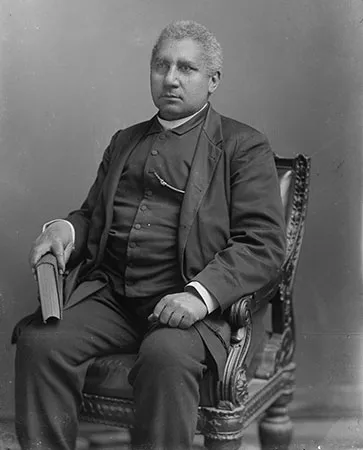
Robert Smalls, who had just turned 23, was immediately hailed as a hero in the North for his audacious deed. His actions were covered by periodicals and newspapers. Southern newspapers demanded severe punishment for the Confederate officers whose joint shore leave had allowed Smalls and his men to steal the boat, and the U.S. Congress passed a bill giving Robert Smalls and his crew the prize money for the Planter, which was valuable for both its guns and its low draft in Charleston Bay. Smalls received US$1,500 of the award money, or $47,245 in 2024. Following the capture, Smalls was asked to go to New York to assist in raising funds for former slaves. However, Du Pont vetoed the plan, and Smalls started working for the Union Navy, particularly because of his in-depth knowledge of mines placed close to Charleston. However, Robert Smalls traveled to Washington, D.C., in August 1862 with Rev. Mansfield French, a Methodist clergyman who had assisted in the founding of Wilberforce University in Ohio and had been dispatched by the American Missionary Association to assist former slaves at Port Royal, at the encouragement of Major General David Hunter, the Union commander at Port Royal. Their goal was to convince Secretary of War Edwin Stanton and President Lincoln to allow African-American men to serve in the Union.
Stanton quickly signed an order allowing up to 5,000 African Americans to enlist in the Union soldiers at Port Royal, despite Lincoln having earlier revoked orders by Generals Hunter, Fremont, and Sherman to deploy African-American troops. The 1st and 2nd South Carolina Regiments (Colored) were formed from those who did. Prior to his transfer to the Army in March 1863, Robert Smalls was employed by the Navy as a civilian. Smalls claims to have witnessed 17 significant Civil War skirmishes and battles. Following its seizure, the Planter needed some repairs, which were completed locally, and it was put into Union service close to Fort Pulaski. In comparison to other vessels in the fleet, the boat’s modest draft made it valuable. Captain Alexander Rhind appointed Robert Smalls as the Crusader’s pilot. When the Planter came back into service in June of that year, an infantry regiment fought at the Battle of Simmon’s Bluff at the head of the Edisto River while Smalls was flying the Crusader on Edisto in Wadmalaw Sound.
He kept flying the Planter and the Crusader. He had helped build mines (then known as “torpedoes”) along the river and coast while he was a slave. As a pilot, he now assisted in locating and eliminating them and maintained the blockade between Beaufort and Charleston. In addition, he witnessed other confrontations at Adam’s Run on the Dawho River, Rockville, John’s Island, and the Second Battle of Pocotaligo where the Planter was fired upon.
Under Captain Rhind once more, he was appointed pilot of the ironclad USS Keokuk and participated in the attack on Fort Sumter on April 7, 1863, which served as a prelude to the Second Battle of Fort Sumter later that autumn. After taking 96 hits, the Keokuk retired for the night before sinking the following morning. The fleet returned to Hilton Head after Robert Smalls and a large portion of the crew relocated to the Ironside.
Commission and Prize Money
Smalls’s reward for capturing the Planter has drawn criticism, and his standing in the Union Army and Navy has been called into question. According to writings about Smalls’ life, the Navy refused to grant him the rank of pilot when he was assigned to fly the Planter because he had not completed the naval academy, which was a prerequisite at the time. He was commissioned as a second lieutenant in the 1st South Carolina Colored Infantry Regiment (later renamed the 33rd U.S. Colored Infantry) and assigned to serve as a pilot in order to guarantee that he would be paid appropriately for a captain. According to numerous accounts, Robert Smalls was elevated to captain by General Gillmore in December 1863 after saving the Planter from an attack close to Secessionville. According to later accounts, Smalls was nominally a civilian during the war, but he did acquire a commission in the Army or the Navy. His pay as “commander” of the Planter in 1865 was reported in a newspaper to be $1,800 (or $36,974 in 2024). He and the Planter were in Charleston Harbor with Union ships in 1865, transporting all African Americans who wished to attend the flag-raising ceremony at Ft. Sumter from shore.
Robert Smalls discovered he had not been formally commissioned when he applied for a Navy pension later in life. He stated that Gillmore had given him an official commission, but he had misplaced it. A bill to place him on the Navy retired list was approved by a committee in 1883, but it was ultimately shelved, purportedly because Smalls was African American. Smalls received a $30 monthly pension in 1897 from a special act of Congress, which was equivalent to a Navy captain’s pension.
A report from 1883, when the measure to place Robert Smalls on the Navy retired list was being discussed, said that the Planter’s 1862 appraisal was “absurdly low” and that a fair valuation would have been more than $60,000. But Smalls didn’t get paid again until 1900. Congress established a law that year that compensated Smalls $5,000 for capturing the vessel, less the $1,500 he had received in 1862. Many continued to believe that this was not what he deserved.
After the Civil War
After the war, Robert Smalls went back to his hometown of Beaufort and bought his old slave owner’s home at 511 Prince St., which had been taken by Union tax authorities in 1863 due to nonpayment of taxes. Smalls maintained control of the property even after the previous owner filed a lawsuit to reclaim it. The case established a significant precedent for later instances of a similar nature. Lydia, his mother, spent the rest of her life with him. Later, before she passed away, he permitted the elderly Jane McKee, the wife of his former enslaver, to move into her old house.
Robert Smalls studied to read and write for nine months. He bought a two-story structure in Beaumont to use as an African-American children’s school.
Business Ventures
Robert Smalls and Philadelphia merchant Richard Howell Gleaves started a company in Beaufort in 1866. To meet the needs of freedmen, they founded a store. To aid in his studies, Smalls also employed a teacher. In April of that year, a Civil Rights Act was passed by the Radical Republicans in control of Congress, overriding President Andrew Johnson’s vetoes. In order to grant full citizenship to all Americans, regardless of race, the 14th Amendment was passed in 1868 and adopted by the states.
He made substantial investments in the Charleston–Beaufort area’s economic growth. In 1870, Smalls, together with fellow delegates Joseph Rainey, Alonzo Ransier, and others, established the Enterprise Railroad, an 18-mile horse-drawn railway line that transported passengers and goods between the Charleston wharves and interior depots, in anticipation of a prosperity built on Reconstruction. The railroad’s board of directors was made up completely of African Americans, with the exception of Timothy Hurley, a white lawmaker, newspaper editor, and county treasurer. Its first president was Richard H. Cain. According to author Bernard E. Powers, it is “the most impressive commercial venture by members of Charleston’s black elite.” Beginning in 1872, Smalls was the owner and publisher of the Beaufort Southern Standard.