The Sojourner Truth biography is the story of a woman who was never supposed to have a voice — and who used that voice to shake the conscience of an entire nation. Born into slavery around 1797 as Isabella Baumfree, she escaped with her infant daughter in 1826, legally reclaimed her son from a slaveholder in 1828, and by 1843 had renamed herself Sojourner Truth because she believed God had called her to travel and speak His truth to a world that desperately needed to hear it. What followed was one of the most extraordinary lives ever lived on American soil.
One of the most documented chapters in the Sojourner Truth biography is her 1851 lecture tour through central and western New York State alongside abolitionist and speaker George Thompson. Sojourner Truth gave her well-known impromptu statement on women’s rights, which became known as “Ain’t I a Woman?” during the Ohio Women’s Rights Convention in Akron, Ohio, in May. In her remarks, she called for all women to have equal human rights. She also talked as a former slave, fusing appeals for women’s rights with abolitionism and using her strength as a worker to support her claims for equal rights.
Both Frances Dana Barker Gage and Hannah Tracy, who were present when Sojourner Truth spoke, planned the gathering. A month later, Rev. Marius Robinson, the owner and editor of the newspaper who was present, published the first of several recorded versions of Truth’s remarks in the Anti-Slavery Bugle. The question “Ain’t I a Woman?” was not mentioned ren Robinson’s account of the speech or in any of the other newspapers that covered it at the time. In May 1863, twelve years later, Gage released an entirely different version. It was very different from the speech Robinson had described, and Truth’s speech pattern seemed to reflect traits of Black slaves in the southern United States.
Because that question was asked four times, Gage’s rendition of the speech—known as “Ain’t I a Woman?”—became the most widely shared version. Given that Truth was born and reared in New York and spoke only upper New York State low-Dutch until she was nine years old, it is quite unlikely that her own speech pattern was like this.
Sojourner Truth stated the following in the version that Rev. Marius Robinson recorded:
I want to say a few words about this matter. I am a woman’s rights. [sic] I have as much muscle as any man, and can do as much work as any man. I have plowed and reaped and husked and chopped and mowed, and can any man do more than that? I have heard much about the sexes being equal. I can carry as much as any man, and can eat as much too, if I can get it. I am as strong as any man that is now. As for intellect, all I can say is, if a woman have a pint, and a man a quart – why can’t she have her little pint full? You need not be afraid to give us our rights for fear we will take too much, – for we can’t take more than our pint’ll hold. The poor men seems to be all in confusion, and don’t know what to do. Why children, if you have woman’s rights, give it to her and you will feel better. You will have your own rights, and they won’t be so much trouble. I can’t read, but I can hear. I have heard the Bible and have learned that Eve caused man to sin. Well, if woman upset the world, do give her a chance to set it right side up again. The Lady has spoken about Jesus, how he never spurned woman from him, and she was right. When Lazarus died, Mary and Martha came to him with faith and love and besought him to raise their brother. And Jesus wept and Lazarus came forth. And how came Jesus into the world? Through God who created him and the woman who bore him. Man, where was your part? But the women are coming up blessed be God and a few of the men are coming up with them. But man is in a tight place, the poor slave is on him, woman is coming on him, he is surely between a hawk and a buzzard.
In contrast to Robinson’s testimony, Sojourner Truth stated in Gage’s 1863 version that her 13 children were sold into slavery. Truth was never known to have further children, and it is generally accepted that she had five, one of which was sold. Gage wrote in 1851 that Akron and the press in particular were generally supportive of the woman’s rights convention, but in 1863 she wrote that the convention leaders were afraid of the “mobbish” opponents. This contradicts Gage’s 1863 memory of the convention. According to several eyewitness accounts of Truth’s address, everyone was “beaming with joyous gladness” during the session, and not “one discordant note” broke the harmony of the proceedings. According to reports from the time, Sojourner Truth was well received by the attendees of the convention, most of whom were ardent abolitionists who supported progressive racial and civil rights ideologies. Truth was received with hisses and voices clamoring to stop her from speaking in Gage’s 1863 rendition. In reality, there had been violent responses to other interracial meetings of white and black abolitionist women, like the burning of Pennsylvania Hall.
Sojourner Truth contended, “That man over there says that women need to be helped into carriages, and lifted over ditches, and to have the best place everywhere,” according to Frances Gage’s account from 1863. No one in the greatest place aids me. And am I not a woman? “Ain’t I a Woman” by Truth demonstrated the lack of acknowledgment that black women endured during this period and will persist long after her time. Angela Davis noted, “Black women, of course, were virtually invisible within the protracted campaign for woman suffrage,” bolstering Truth’s claim that no one offers her “any best place”—not just her, but black women in general.
Sojourner Truth addressed scores, if not hundreds, of audiences throughout the course of the following ten years. Working with Ohio Anti-Slavery Bugle editor Marius Robinson, Truth gave speeches throughout the state from 1851 to 1853. She met Harriet Beecher Stowe in 1853 while giving a speech at a suffragist “mob convention” at the Broadway Tabernacle in New York City. She went to Battle Creek, Michigan, in 1856 to give a speech to the Friends of Human Progress.
Sojourner Truth Biography: Her Role in the Fight for African American Women’s Rights
Truth devoted her life to advocating for voting rights, property rights, abolition, and a more equitable society for women and African Americans. She led the charge in addressing interconnected social justice issues. “When Black women like Truth spoke of rights, they mixed their ideas with challenges to slavery and to racism,” noted historian Martha Jones. Sojourner Truth shared personal tales that implied a different path for the women’s movement, one that supported the interests of all people.
In 1853, Sojourner Truth, Stephen Symonds Foster, Abby Kelley Foster, Jonathan Walker, Marius Robinson, and Sallie Holley formed the Michigan Anti-Slavery Society in Adrian, Michigan. In Ann Arbor, Michigan, the state society was established in 1836.
Sojourner Truth purchased a nearby site in Northampton in 1856, but she did not stay there for very long. She sold Daniel Ives all of her belongings, both new and old, on September 3, 1857, and relocated to Battle Creek, Michigan, where she reunited with former Millerite movement members who had founded the Seventh-day Adventist Church. Early antislavery efforts had started in Ohio and Michigan. She also joined the Progressive Friends, the core group of Michigan abolitionists, some of whom she had previously met at national conventions. Truth resided in the Spiritualist utopia of Harmonia, Michigan, from 1857 until 1867.
After that, she relocated to the neighboring town of Battle Creek, Michigan, where she lived at 38 College St. until her passing in 1883. Her daughter Elizabeth Banks (age 35) and her grandsons James Caldwell (spelled incorrectly as “Colvin”; age 16) and Sammy Banks (age 8) were living with her in Harmonia, according to the 1860 census.
During the Civil War, Sojourner Truth assisted in enlisting African American males in the Union army. James Caldwell, her grandson, joined the 54th Massachusetts Regiment. In 1864, Truth worked hard to better the lot of African-Americans while working for the National Freedman’s Relief Association in Washington, D.C. President Abraham Lincoln invited her to the White House in October of that year. While employed at Washington’s Freedman’s Hospital in 1865, Truth participated in the streetcars’ forced desegregation.
“The Valiant Soldiers” is a song that Sojourner Truth is credited with writing for the 1st Michigan Colored Regiment. It was reportedly written during the war and performed by her in Detroit and Washington, D.C. “John Brown’s Body” or “The Battle Hymn of the Republic” are the songs to which it is sung. The notion that Truth wrote the verses has been contested (see “Marching Song of the First Arkansas”).
Legacy
Monuments and statues
No Sojourner Truth biography is complete without examining the extraordinary legacy she left carved in stone, bronze, and institutional memory across America. From Michigan highways to New York libraries, her name has been immortalised in ways that few activists of any era have ever achieved.
Michigan
In 1935, a stone memorial was erected in Monument Park’s Stone History Tower in Battle Creek, creating the first historical marker honoring Sojourner Truth. Highway M-66 in Calhoun County, which runs from the county line south of Athens to Morgan Road in Pennfield Township, northeast of Battle Creek, was named the Sojourner Truth Memorial Highway by the State of Michigan as an additional tribute to her legacy.
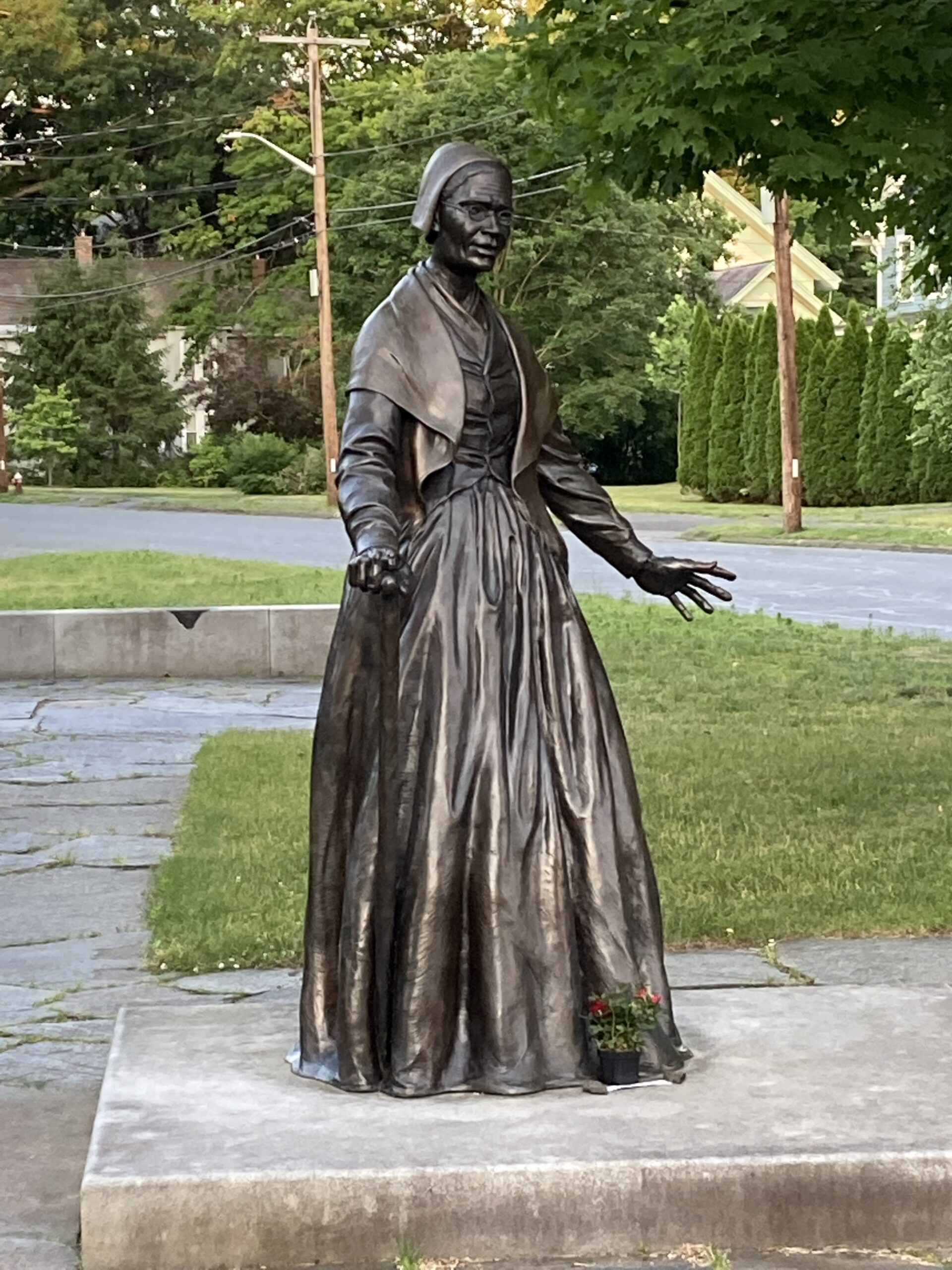
The anticipated bicentennial of Sojourner’s birth occurred in 1999. A life-size sculpture of Sojourner Truth by Tina Allen was installed to Monument Park in Battle Creek to commemorate the event. The bronze statue of Sojourner stands 12 feet tall.
Ohio
On the location of the Universalist “Old Stone” Church in Akron, where Sojourner Truth delivered her “Ain’t I a Woman?” address on May 29, 1851, an Ohio Historical Marker was unveiled in 1981. In 2024, Sojourner Truth Legacy Plaza opened in Akron, with a statue of her by artist and Akron resident Woodrow Nash.
Works of art
The Sojourner Truth biography has inspired artists, composers, and sculptors for more than a century — a testimony to how deeply her life embedded itself into the cultural memory of America.
I’m Sojourner Truth is a print that Elizabeth Catlett made in 1945 as part of a series celebrating the work of Black women. The print is part of the collection of the Metropolitan Museum of Art. Later on, she produced a full-size statue of Truth that was on exhibit in Sacramento, California.
The Contribution of Negro Woman to American Life and Education is a mural that African-American artist John Biggers made for his doctoral dissertation in 1958. It features Sojourner Truth, Harriet Tubman, and Phillis Wheatley and was unveiled at the Blue Triangle Community Center (formerly YWCA) in Houston, Texas.
Between 1974 and 1979, feminist artist Judy Chicago (Judith Sylvia Cohen) produced a collaborative masterwork called The Dinner Party, a mixed-media art project, which was influenced by the work of pioneering women’s historian Gerda Lerner. One of 39 is the Sojourner Truth placesetting. In 2000, the Elizabeth Sackler Foundation gave The Dinner Party to the Brooklyn Museum’s Elizabeth A. Sackler Center for Feminist Art in New York.
Bell Hooks, a feminist theorist and writer, named her first significant work after Truth’s “Ain’t I a Woman?” speech. In 1981, the book was released.
In Memoriam: Sojourner Truth was written by African-American composer Gary Powell Nash in 1992.
An shortened version of Truth’s “Ain’t I a Woman?” speech appears as a spoken-word part ren the 1999 Broadway musical The Civil War. Maya Angelou performed the song on the 1999 cast recording.
Sojourner Truth: Ain’t I A Woman?, a crocheted mural, was shown on the exterior wall of the Akron Civic Theatre in Lock 3 Park, Ohio, in 2018. As part of the “Love Across the U.S.A.” initiative led by fiber artist OLEK, it was one of four projects in North Carolina and New York.
Libraries, schools, and buildings
- In 1971, New Paltz State University of New York named the Sojourner Truth Library after Truth.
- The Lenny Bruce House was renamed Sojourner Truth House in her honor in 1980 by the University of Michigan’s Inter Cooperative Council and its occupants.
- In 1991, Summit County, Ohio, unveiled the reinstalled Ohio Historical Marker on the building wall and dedicated the refurbished Danner Press Building in Akron as the Sojourner Truth Building.
- In 2004, the King’s College in New York City, housed within the Empire State Building, dubbed one of its residences “The House of Sojourner Truth”.
- Rutgers University dedicated its College Avenue Apartments to the Sojourner Truth Apartments in honor of Truth and her parents’ enslavement by relatives of their first president.
- Named for Frederick and Truth Douglass, Sojourner–Douglass College in Baltimore closed in 2019.
- As of February 2020, K–12 and primary schools in a number of states bear Truth’s name.
Key Works That Tell the Sojourner Truth Biography in Full
For readers who want to go deeper into the Sojourner Truth biography, her own memoir remains the most essential starting point. The Narrative of Sojourner Truth: A Northern Slave, first published in 1850, is a raw and remarkable account of her life in slavery, her escape, and her early years as a speaker and activist. It is available in a Penguin Classics edition with notes by scholar Nell Irvin Painter, and in a Dover Publications edition. Both are widely accessible and give every reader direct access to her story in her own words.
The Sojourner Truth biography does not end with her death in 1883. It continues every time a woman stands up in a room where she is not expected to speak. It continues every time a person of faith decides that justice is not a political issue but a Biblical one. Truth understood something that many Christians still wrestle with — that the God who heard the cry of enslaved Israel also heard the cry of enslaved America, and that He raises up voices in every generation to say what most people are too comfortable to say. Her voice was one of those. The only question her biography leaves the reader with is: will yours be?