Emil Kapaun was an American Catholic priest and US Army captain who fought as a chaplain in both World War II and the Korean War. He was born on April 20, 1916, and died on May 23, 1951.
After serving as a chaplain in the Burma Theater of World War II, Emil Kapaun was captured while serving as a chaplain with the U.S. Army in Korea. He passed away in a camp for prisoners of war. For his actions in Korea, Kapaun was posthumously awarded the Medal of Honor in 2013. He received the Medal of Honor, making him the ninth American military chaplain to do so. On March 2, 2021, the Defense POW/MIA Accounting Agency (DPAA) declared that Kapaun’s body has been located.
He was proclaimed a Servant of God by Pope John Paul II in 1993, marking the beginning of the Catholic Church’s canonization process. He was deemed Venerable by Pope Francis in 2025, marking the next step toward canonization.
Early Life
Born on April 20, 1916, Emil Kapaun was raised on a farm on rural 260th Street in Marion County, Kansas, three miles (4.8 km) southwest of Pilsen. Enos and Elizabeth (Hajek) Kapaun, his parents, were immigrants from the Czech Republic. May 1930 marked his graduation from Pilsen High School. Additionally, Kapaun received degrees from Kenrick Theological Seminary in St. Louis, Missouri, in 1940, and Conception Abbey Seminary College (College of New Engleberg; Conception Seminary College) at Conception, Missouri, in June 1936.
Catholic Military Chaplains
At what is now Newman University in Wichita, Kansas, Bishop Christian Herman Winkelmann ordained Emil Kapaun as a Catholic priest of the Diocese of Wichita on June 9, 1940. At Pilsen, Kansas’ St. John Nepomucene Catholic Church, he attended his first Mass. Kapaun was assigned as an auxiliary chaplain to the Herington Army Airfield, which is located close to Herington, Kansas, in January 1943.
U.S. Army Service
In August 1944, Emil Kapaun enrolled in the U.S. Army Chaplain School at Ft. Devens, Massachusetts. He graduated in October and started serving as a military chaplain in Camp Wheeler, Georgia. He served over 19,000 service members alongside another chaplain. From April 1945 to May 1946, he was deployed to India and worked in the Burma Theater. He occasionally traveled approximately 2,000 miles (3,200 km) per month by jeep or airplane while serving local missions and American soldiers. In January 1946, he received a promotion to captain. In July 1946, he was discharged from active duty. In February 1948, he graduated from Catholic University of America with a Master of Arts in Education thanks to the G.I. Bill. He rejoined the U.S. Army in September 1948 and took up his chaplaincy at Fort Bliss, which is close to El Paso, Texas. Kapaun finally left his parents and Pilsen in December 1949, traveling to Japan.
Emil Kapaun Occupation of Japan
Emil Kapaun joined the 8th Cavalry Regiment, 1st Cavalry Division, as a chaplain in January 1950. He frequently conducted battle training close to Mount Fuji, Japan. Less than a month after North Korea attacked South Korea, on July 15, 1950, the 1st Cavalry Division and Kapaun set sail for Korea from Tokyo Bay.
Korean War Chaplains
On July 18, 1950, the 1st Cavalry Division executed the first amphibious landing of the Korean War. In order to impede the North Korean Korean People’s Army’s (KPA) advance until additional forces could arrive, the Division was quickly elevated. The division and the KPA participated in multiple clashes, but each time they were forced to retire. During one of these withdrawals, Kapaun and his aide discovered that a wounded soldier had been left stranded by hostile machine gun and small arms fire. The two faced enemy fire and saved the man’s life, knowing that there were no litter bearers available. Kapaun received the Bronze Star Medal with a “V” device for courage.
The American forces were pushed back into a perimeter around the port city of Pusan by the KPA. Emil Kapaun kept going about encouraging and praying with the 8th Regiment’s soldiers. Lack of sleep for weeks at a time was his biggest grievance. After the landing at Inchon in mid-September, Kapaun and the other forces of the United Nations Command eventually managed to break out of the cordon and chase the KPA north. The division advanced to within 50 miles (80 km) of the Chinese border on October 9 after crossing the 38th parallel into North Korea and taking Pyongyang, the country’s capital.
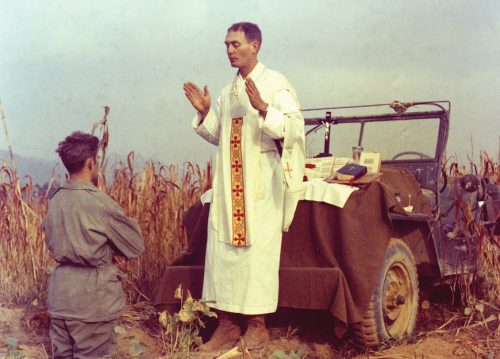
Over the course of the months-long conflict, Emil Kapaun earned a reputation for his valiant service to the troops, his ability to save the dead and injured, and his ability to minister to the living by administering Holy Communion, hearing confessions, performing baptisms, and celebrating Mass on a makeshift altar erected on the front end of a Jeep. His Mass kit Jeep and trailer were repeatedly destroyed by enemy fire. He expressed in letters to his family that he firmly believed that the prayers of others were what kept him alive.
Prisoner of War
The Chinese People’s Volunteer Army (PVA) unexpectedly intervened as the UN forces advanced north. The Battle of Unsan, which took place on November 1-2, 1950, close to Unsan, North Korea, was the first encounter with this new foe. The 8th Cavalry Regiment of Kapaun was attacked by over 20,000 PVA soldiers. He remained with the 800 men of the 3rd Battalion as the rest of the regiment withdrew, despite cries for him to flee. He was later given the Medal of Honor for his bravery in the face of hostile fire while saving almost forty men. The U.S. 5th Cavalry Regiment made multiple fruitless attempts to save the struggling 3rd Battalion. After being captured, Kapaun and other 3rd Battalion men marched 87 miles (140 km) to a makeshift prison camp at Sombakol, which was close to the main jail (Prison Camp 5) at Pyoktong, North Korea, where they were subsequently detained. Some inmates who had disobeyed authorities’ orders to transport the injured were convinced to do so by Kapaun.
Malnutrition, illness, lice, and bitter cold could kill up to two dozen prisoners every day in the prison camp. Emil Kapaun resisted giving in to hopelessness. He dug latrines, arbitrated conflicts, distributed his food, and boosted spirits. Among his fellow prisoners of war, he was known for stealing food so the men could eat it. He also led the men in prayer, resisted communist brainwashing, and smuggled medications for dysentery to Sidney Esensten, the physician.
Emil Kapaun Death and burial
In addition to diarrhea and pneumonia, Emil Kapaun experienced a blood clot in one of his legs.1 As the months went by, he grew weaker, yet on Sunday, March 25, 1951, he led an Easter daybreak service.
Due to his extreme weakness, the prison guards sent him to a location in the Pyoktong camp known as the “hospital,” where he passed away on May 23, 1951, from pneumonia and malnourishment. Father Kapaun was reportedly interred in a mass burial close to the Yalu River. William Hansen, one of Kapaun’s fellow captives, claimed in 2005 that he and the other inmates had buried Kapaun separately in a single grave on higher ground, marking the location with stones.
Twelve chaplains perished in Korea, including him. In 1950, four chaplains from the United States Army were captured; they all perished while being held captive.
Although they could not be recognized, Kapaun’s remains were one of the 1,868 delivered to American possession in Operation Glory as part of the 1953 Korean Armistice Agreement. Around 1956, his remains were interred at Honolulu, Hawaii’s National Memorial Cemetery of the Pacific (NMCP). As part of the Korean War Disinterment Project, a seven-phase initiative started in 2018 by the Defense POW/MIA Accounting Agency to disinter all surviving Korean War Unknowns from the NMCP, his remains were identified and disinterred.
The Catholic Diocese of Wichita and U.S. Senator Jerry Moran announced the identification of Emil Kapaun’s remains on March 4, 2021.
The Hartman Arena in Park City, close to Wichita, hosted a Mass of Christian Burial on September 29, 2021, in Kapaun’s native Kansas. His remains were then transported by horse-drawn caisson to the Cathedral of the Immaculate Conception in Wichita, where they were interred inside the structure with full military honors.
Medal of Honor Chaplain
He received the Distinguished Service Cross posthumously on August 18, 1951, for his exceptional actions on November 1–2, 1950. But Kapaun’s fellow troops and prisoners of war believed he should have received the Medal of Honor. U.S. Representative Todd Tiahrt started a campaign in 2001 to grant Kapaun the Medal of Honor. Secretary of the Army Pete Geren agreed that Kapaun was deserving of the medal in a letter to Tiahrt prior to his departure from office on September 16, 2009. The Joint Chiefs of Staff Chairman, Admiral Michael Mullen, concurred.
In the National Defense Authorization Act for Fiscal Year 2012 (Senate Bill 1867, Section 586), the president was authorized and asked to elevate Kapaun’s Distinguished Service Cross to the Medal of Honor for his valiant actions during the Battle of Unsan on November 1-2, 1950, and while he was a prisoner of war until his death on May 23, 1951. On April 11, 2013, President Obama gave Kapaun’s nephew the medal that had been given on his behalf at the White House.
The following is his Medal of Honor citation:
The President of the United States of America, authorized by Act of Congress, March 3, 1863, has awarded in the name of Congress the MEDAL OF HONOR to
CHAPLAIN (CAPTAIN) EMIL. J, KAPAUN
UNITED STATES ARMY
for conspicuous gallantry and intrepidity at the risk of his life above and beyond the call of duty:
Chaplain Emil J. KAPAUN distinguished himself by acts of gallantry and intrepidity above and beyond the call of duty while serving with the 3rd Battalion, 8th Cavalry Regiment, 1st Cavalry Division during combat operations against an armed enemy at Unsan, Korea, from November 1–2, 1950. On November 1, as Chinese Communist Forces viciously attacked friendly elements, Chaplain KAPAUN calmly walked through withering enemy fire in order to provide comfort and medical aid to his comrades and rescue friendly wounded from no-man’s land. Though the Americans successfully repelled the assault, they found themselves surrounded by the enemy. Facing annihilation, the able-bodied men were ordered to evacuate. However, Chaplain KAPAUN, fully aware of his certain capture, elected to stay behind with the wounded. After the enemy succeeded in breaking through the defense in the early morning hours of November 2, Chaplain KAPAUN continually made rounds, as hand-to-hand combat ensued. As Chinese Communist Forces approached the American position, Chaplain KAPAUN noticed an injured Chinese officer among the wounded and convinced him to negotiate the safe surrender of the American Forces. Shortly after his capture, Chaplain KAPAUN, with complete disregard for his personal safety and unwavering resolve, bravely pushed aside an enemy soldier preparing to execute Sergeant First Class Herbert A. Miller. Not only did Chaplain KAPAUN’S gallantry save the life of Sergeant Miller, but also his unparalleled courage and leadership inspired all those present, including those who might have otherwise fled in panic, to remain and fight the enemy until captured. Chaplain KAPAUN’S extraordinary heroism and selflessness, above and beyond the call of duty, are in keeping with the highest traditions of military service and reflect great credit upon himself, the 3rd Battalion, 8th Cavalry Regiment, the 1st Cavalry Division, and the United States Army.
Barack Obama
Christian Wartime Miracles
Due to damage to several organs, auto-immune disease sufferer Avery Gerleman went into an 87-day coma in 2006. Emil Kapaun recovered thanks to the intercession of her parents and other people. Subsequent examinations of her injured kidneys and lungs revealed no evidence of scarring. After that, Avery started exercising, graduated from Wichita Area Technical College as a licensed practical nurse, and intends to become a registered nurse.
On Father Kapaun Day, June 29, 2008, the opening ceremony for Kapaun’s canonization was place at St. John Nepomucene Catholic Church in Pilsen, Kansas.
The Roman postulator for Kapaun’s canonization, Andrea Ambrosi, traveled to Wichita on June 26, 2009, to speak with physicians regarding purported miraculous occurrences.
Chase Kear, a 20-year-old who survived a serious brain injury last year, is one of them. He and his family made this claim in part because they asked Emil Kapaun to act on their behalf. In October 2008, Kear, a member of the Hutchinson Community College track team, fell on his head during pole vaulting practice. Despite being on the verge of death, he is reportedly miraculously recovered. Kear’s case will be looked into by the Diocese of Wichita’s judicial vicar, Rev. John Hotze, who has training in canon law.
Hotze has been researching Kapaun’s potential sainthood for eight years. Since troops were freed from Korean prisoner-of-war camps in 1953 and learned of Kapaun’s bravery and faith, the Catholic Church has contemplated canonizing him.